
19. Umbro 'Festival' (2007-09) *
Chris Oakley | 17 October 2026
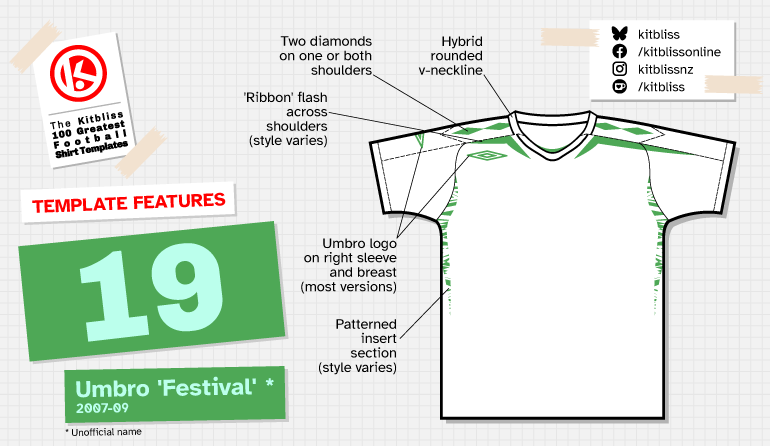
No-one can say Umbro didn't try. In 2007, they unleashed a football kit template that was so advanced that no-one has managed to create anything quite like it since. Full of detail, not all of which was mandatory, it encapsulated an artistic spirit that ensured nearly every version was unique.
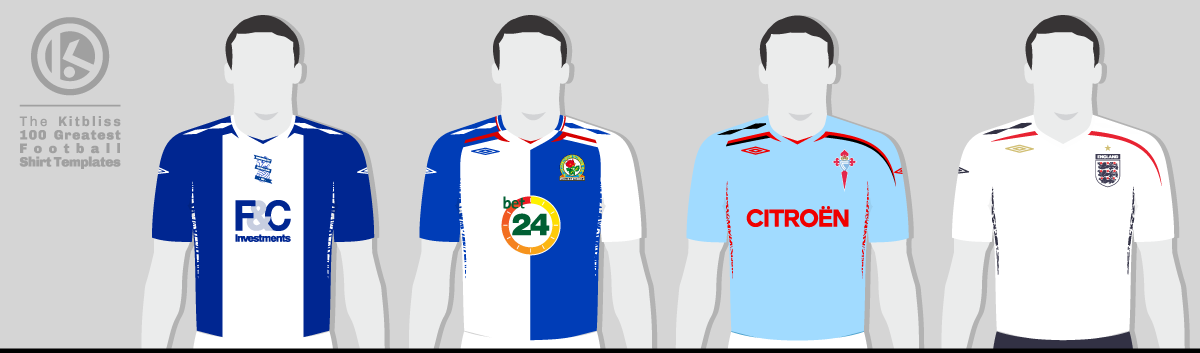
From left: Birmingham City (2007-08 home), Blackburn Rovers (2007-08 home), Celta Vigo (2008 home), England (2007-09 home).
The template had much to tempt the eye. Starting at the shoulders, Umbro evoked memories of its previous work between 1975 and 1981 with the use of two solid diamonds on each shoulder. As we'll come to discover, however, this could be tweaked to suit the needs of the team wearing it. If required, the diamonds could appear on only the right shoulder to create a more asymmetric look. Furthermore, the diamonds could be housed within their own 'epaulettes' — sections of fabric that could be given a secondary colour to make the diamonds stand out better.
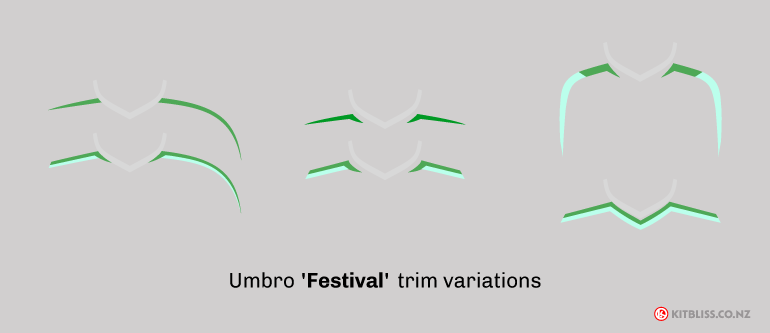
Below the diamonds came a form of decoration that was so varied that it could hardly be said to have a standard form. Teams could choose between a ribbon running from the right shoulder to the left arm, tapered flashes either side of the neckline, or an extended version of the flashes that ran down to the underarm area. Even those options weren't enough for Hull City, whose away shirt ended up with a cross-shoulder double stripe that ran along the lower part of the neckline.
Trim variations within the Umbro 'Festival' shirt template.
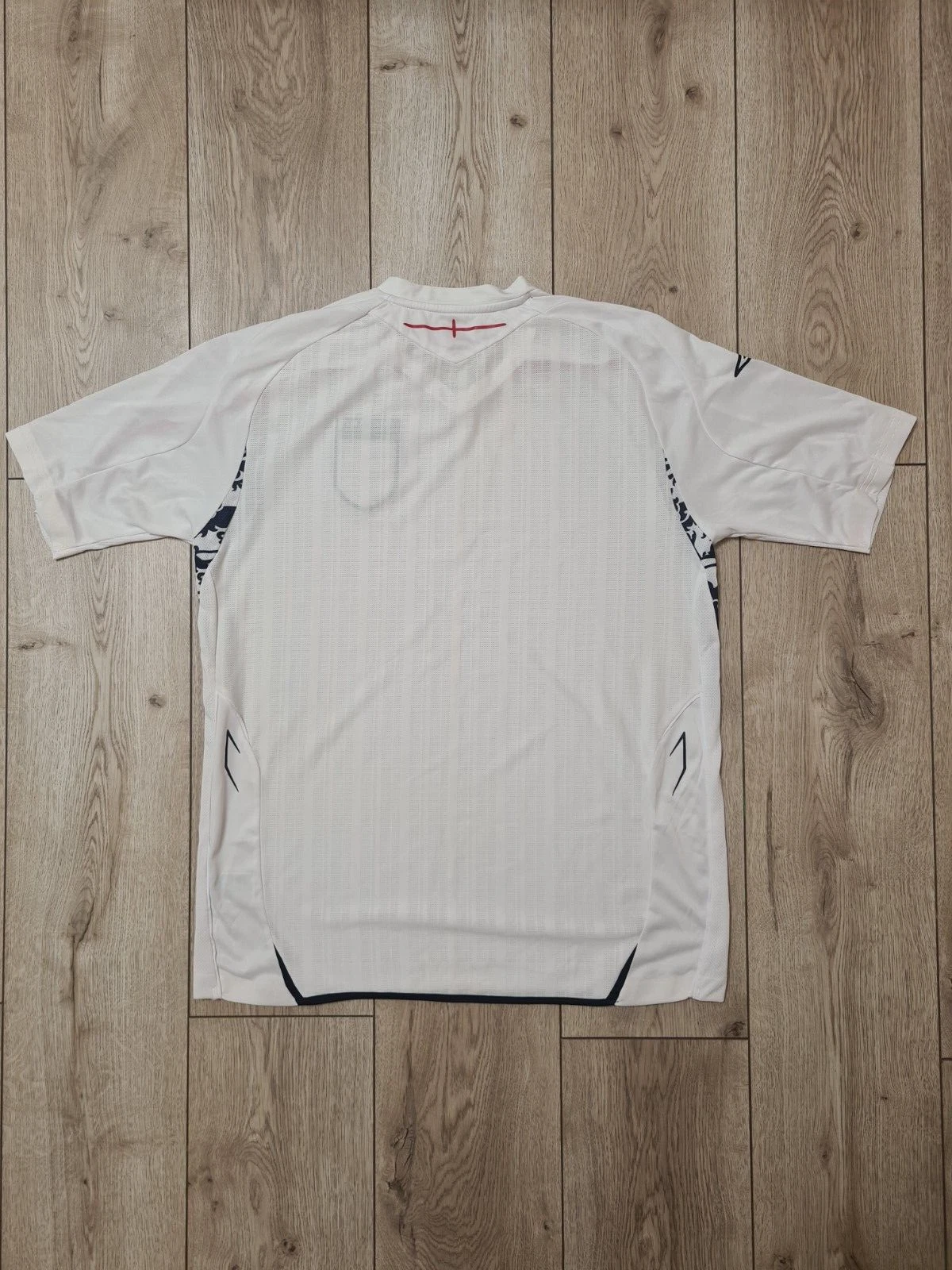
Each of the first three options was available in single-colour or double-colour varieties, but some teams did away with this feature altogether. The same flexibility applied to one of the template's most distinctive elements: the underarm side panels. These panels were curved sinuously and often contained a two-colour abstract pattern made up of Umbro diamonds. In certain cases, however, the pattern was based on elements of the team's own logo, as in the versions worn by West Ham and England. One or two teams wore panels with no pattern at all, while other teams wore shirts with no panels. Are you beginning to see just how customisable this template was?
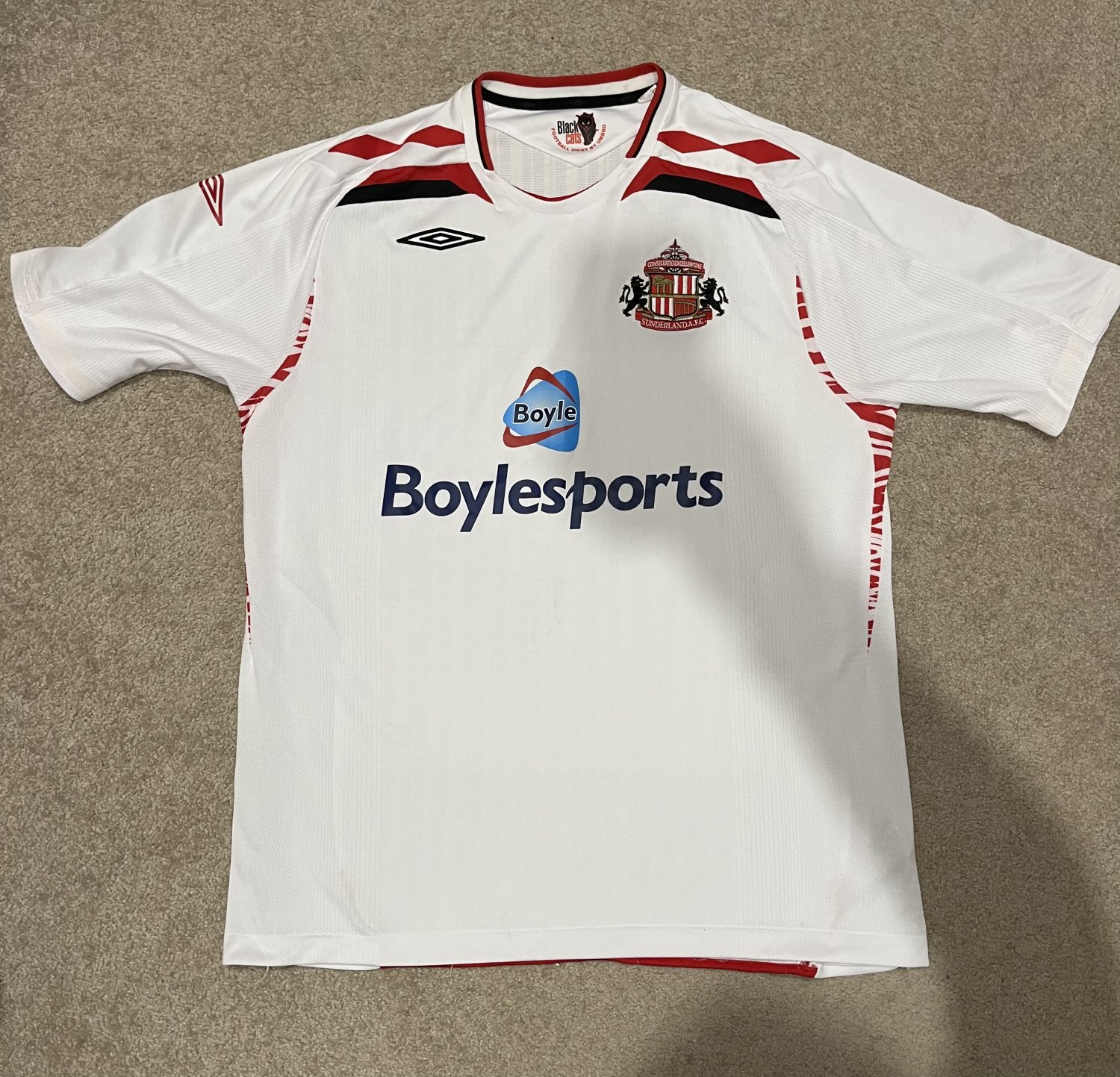

Further variations included the additional decoration at the ends of the 'epaulettes' on CSKA Moscow's shirts, the extra-coloured trim on the otherwise simple necklines of Glentoran's and Sunderland's away shirts, and the winged collars sported by Wigan Athletic and West Bromwich Albion. Even the Umbro double-diamond logo could appear on either sleeve, both sleeves or neither. This was truly a template with enough items on the menu to satiate even the heartiest appetite for great shirt design.
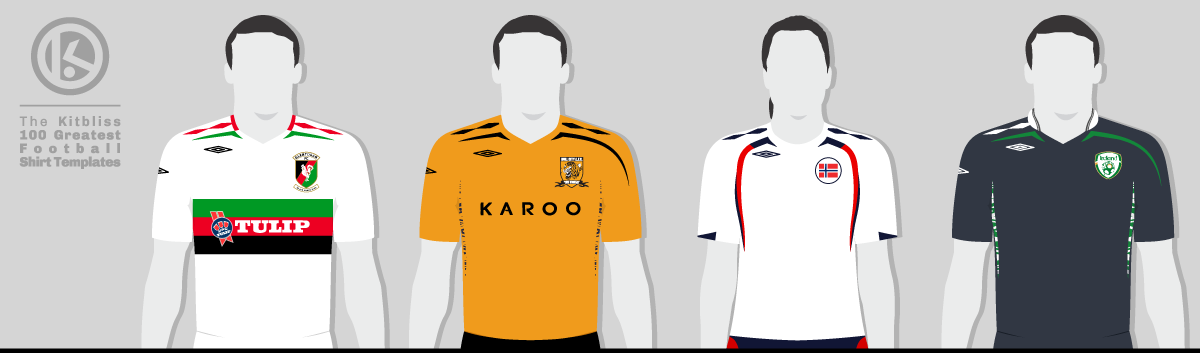
From left: Glentoran (2007 home), Hull City (2007-08 home), Norway Women (2007 away), Republic of Ireland (2007 away).
With the front of the shirt containing so much ornamentation, the back was left largely untouched, save for a section of fabric on either side featuring what looks like a staple seen from an angle. A little peculiar, perhaps, but somehow in keeping with the overall look — especially when you broaden your view to include the shorts and socks that were often married up with each shirt.
A design that was so multifaceted and interesting to look at deserved its moment in the spotlight, and it certainly had that. England wore it against Brazil at the new Wembley Stadium in 2007, Hull City secured their first-ever promotion to the Premier League in May 2008, and Everton finished fifth in the top flight and embarked on a UEFA Cup campaign during the 2007-08 season. From international football to the highs of promotion and European competition, Umbro's template was there to be seen.
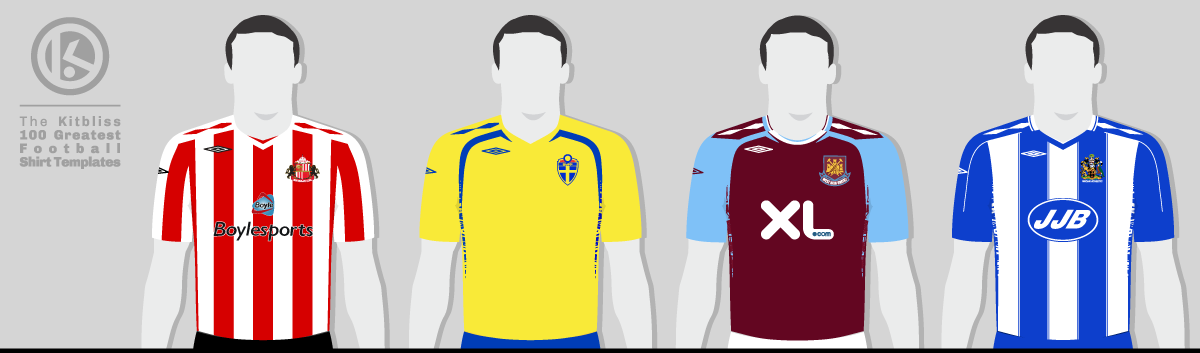
From left: Sunderland (2007-08 home), Sweden (2007-09 home), West Ham United (2007-08 home), Wigan Athletic (2007-08 home).
So at a time when other kit suppliers were wavering between basic simplicity and limited detailing, Umbro clearly took an unabashed approach that unlocked the potential for shirts to be more visually compelling. They deserve great credit for doing so, and the care they took to craft such a distinctive template provided a fitting culmination to an era of flamboyant shirt design. In 2009, Umbro ushered in its 'Tailored by' ethic, producing shirts that relied on neat cuts and stitching rather than elaborate devices to create their visual appeal. That was a new era in its own right, but for now, we were invited to simply enjoy this great example of a job well done. I, for one, was happy to oblige.
My very grateful thanks go to Adam's Shirt Quest and Football Shirt World UK for their help in researching this template.
To see the full set of Umbro 'Festival' * kits, visit the Umbro 'Festival' * template gallery page.
(* unofficial name)