
25. Nike Total 90 (2004-06)
Chris Oakley | 29 March 2026
The popularity of a football shirt template is often tied to its exposure at major international tournaments, yet overexposure can just as quickly render a design monotonous and tiresome. The Nike Total 90 template, notably worn by a quarter of the teams at Euro 2004, is a case in point, though whether it suffered this fate is debatable. What is clear is its notable absence from many lists of the greatest templates — a fact that warrants deeper analysis.
Its lifespan was short, at only two years, but its impact was significant. Launched at the start of 2004, it was worn by many international teams — among them Brazil, the Netherlands, Belgium, Croatia and Portugal. By the time Euro 2004 took place midway through the year, Total 90 kits seemed to be everywhere, worn by the hosts and eventual runners-up among others.
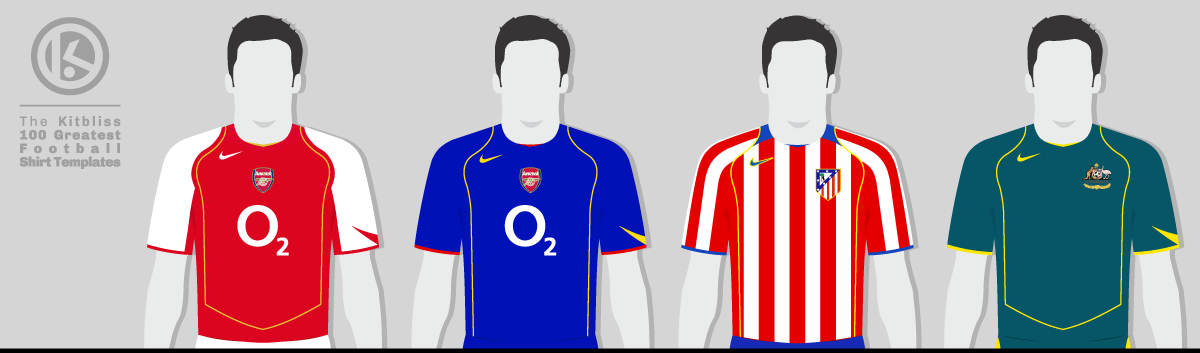
From left: Arsenal (2004-05 home and away), Atlético Madrid (2004-05 home), Australia (2004 home (version 1)).
Come the start of the new domestic season in Europe, club teams were getting in on the act. Arsenal, Juventus, Barcelona, Valencia, Porto, PSG, Atlético Madrid and many more were incorporating that curved piping and peculiar neckline into their own shirts. Nike, it seemed, knew exactly how to impose a design on a global audience.

The design itself was certainly distinctive, but also highly adaptable. The most well-known version featured the aforementioned piping that curved from the shoulder, around the sleeve, and tapered to a point near the lower centre of the shirt. A second version also existed, in which the piping travelled straight down the sides of the shirt and off the bottom edge. This version was worn by many teams — presumably those that found a downward point near the shorts a little too unconventional.


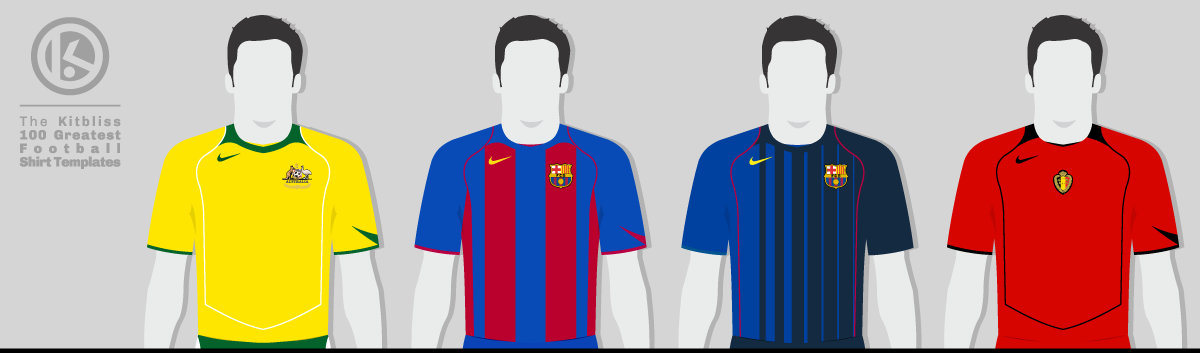
From left: Australia (2004-05 home (version 2)), Barcelona (2004-05 home, 2005 away), Belgium (2004-05 third).
Aside from the dual-approach piping, the shirt also featured a fabric panel forming an unusually shaped neckline that was particularly conspicuous when rendered in a secondary colour. Often, however, it was coloured the same as the rest of the shirt, drawing the eye to the piping alone, save for the contrasting under-layer which appeared as a thin v-shaped detail below the neck.
On the left sleeve of many versions of the shirt was a single pointed flash that appears to be the tail of a reversed Nike ‘swoosh' logo. It's an interesting touch, and may have looked even better had it appeared on both sleeves, although it was completely absent in some versions.
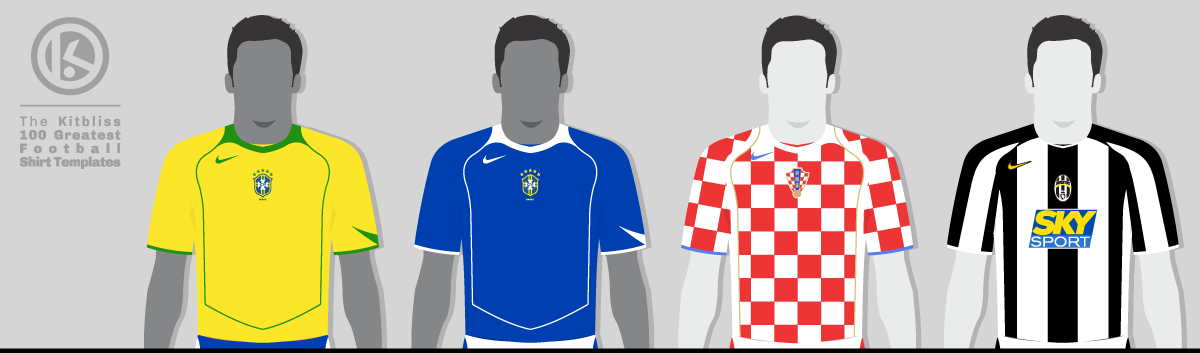
From left: Brazil (2004-05 home, 2004 away), Croatia (2004-05 home), Juventus (2004-05 home).
As for the back of the shirt, it often (but not always) had a panel across the shoulders that housed the name of the player wearing it. When visible, it was given a contrasting colour that made the back of the shirt more striking than the front.

It's therefore fair to say that Nike's Total 90 template had a multitude of elements to catch the eye, but perhaps the best-known of them all was reserved for national teams. The encircled shirt number displayed in the middle of the chest became visual shorthand for Nike's design ethic when it came to this template. Were it not for the necessary inclusion of a main sponsor logo, the circled number may have ended up on many club shirts too. Had that happened, it would have denied Atlético Madrid the chance to promote the branding for any number of different films made by Columbia Pictures. Sometimes, things are just meant to happen the way they do.*

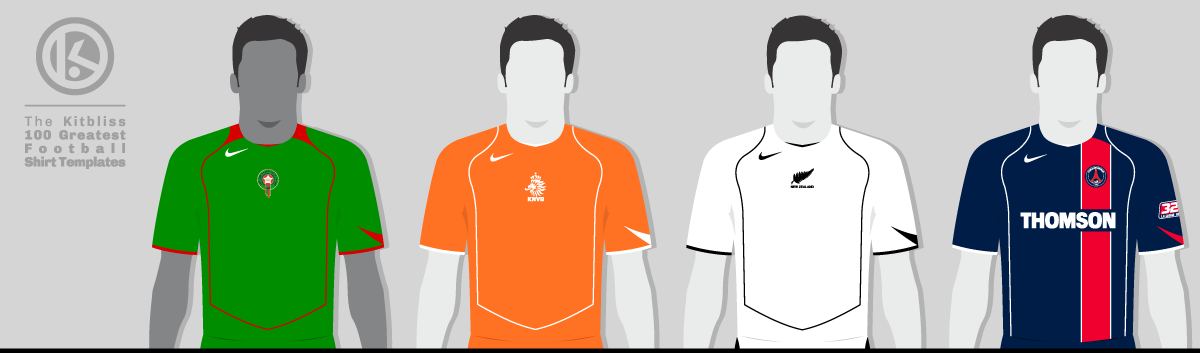
From left: Morocco (2004-06 home), Netherlands (2004-05 home), New Zealand (2004-06 home), Paris Saint-Germain (2004-05 home).
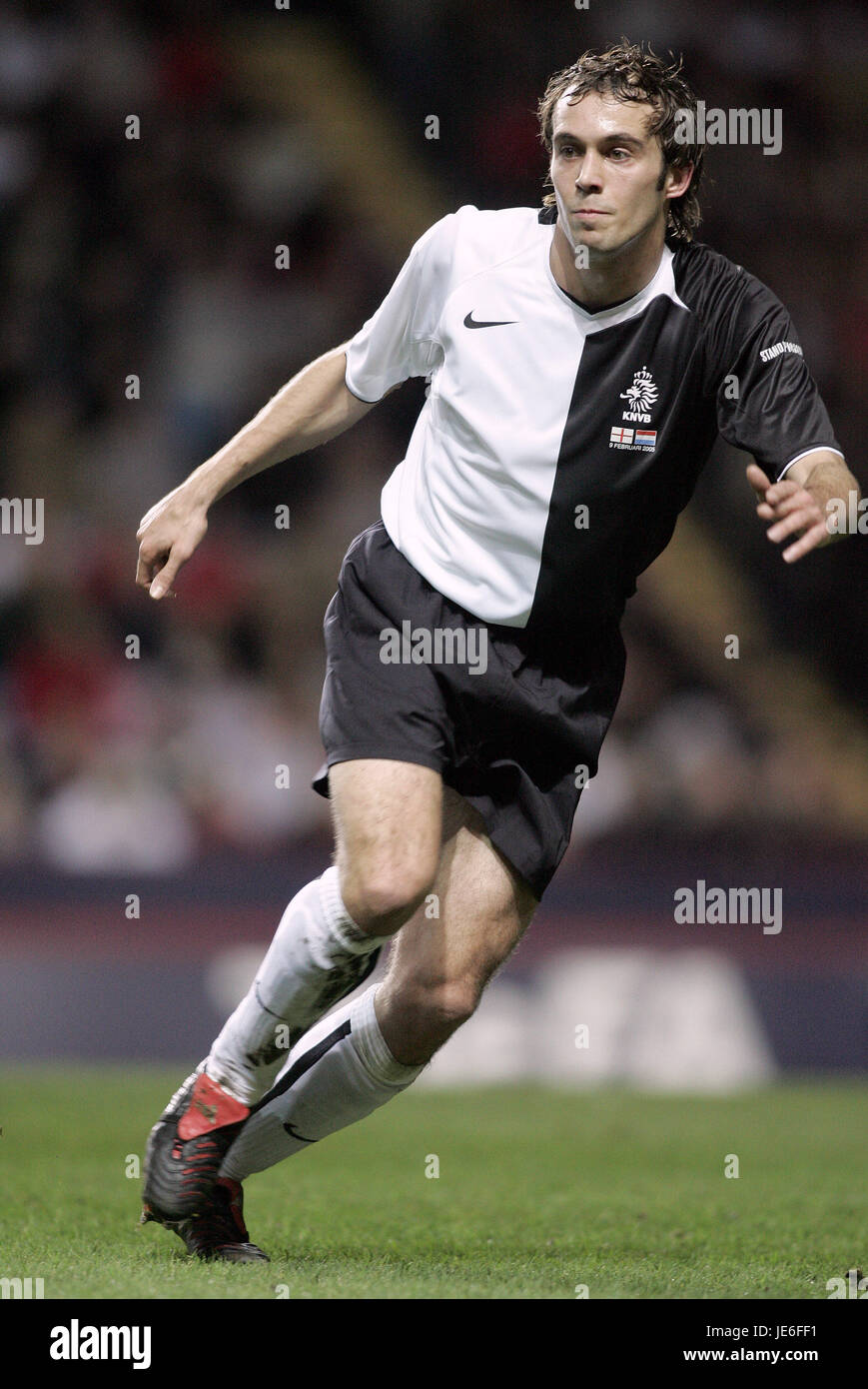
One year after its launch, a number of countries were given the honour of wearing a special Nike kit for a single match to promote the Stand Up, Speak Up campaign which encouraged football fans to speak up against racist abuse in stadia. Backed by Thierry Henry and many of his peers, Nike's one-off shirt was half white and half black — a suitably appropriate design that powerfully conveyed its message to those whose presence in football was unwanted.
Though most of the club team kits were changed at the start of the 2005-06 season, Total 90 continued to be worn by the likes of New Zealand and South Korea well into 2006. By that point, though, Nike's creation had reached saturation point and it was time for everyone to move on.
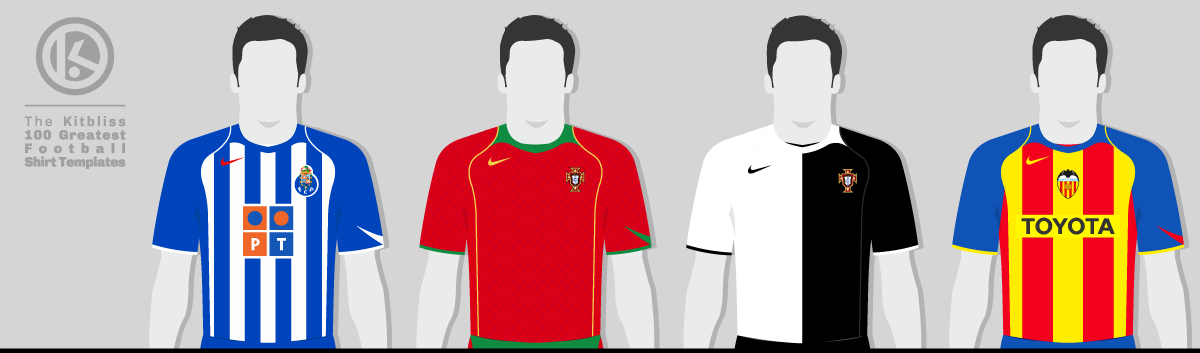
From left: Porto (2004-05 home), Portugal (2004-05 home, 2005 special), Valencia (2004 away).
And yet, and yet... Two decades on, when Nike needed inspiration for a new set of football kits, there was only one template worth reviving. Total 90 returned, and brought with it a fresh appreciation of great design. What goes around, comes around, and I wouldn't mind betting that it'll come around again another twenty years from now.
* Before you ask, no — I didn't illustrate them.
My very grateful thanks go to Adam's Shirt Quest and FSWorld for their help in researching this template.
To see the full set of Nike Total 90 kits, visit the Nike Total 90 template gallery page.