
21. Nike Cool Motion (2002-04)
Chris Oakley | 6 August 2026
It's strange to think that although Nike had been making football kits since the early-1980s (in England, at least), they didn't create a strong template design until 2002. Adidas, for their part, were creating easily identifiable templates from the get-go, or the 1970s, to be precise. We'd have to wait until the 21st century to see the first unmistakably Nike template.

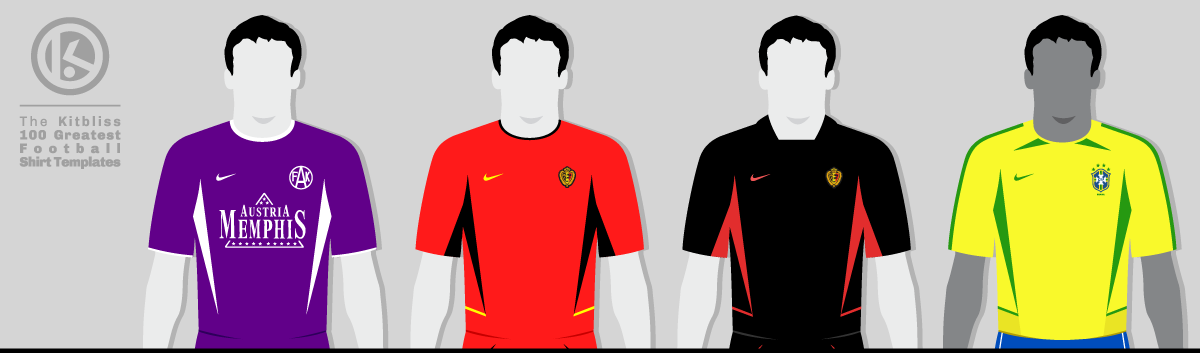
From left: Austria Vienna (2002-04 home), Belgium (2002-04 home, 2003 away), Brazil (2002-03 home).
The 17th FIFA World Cup took place in Asia for the first time, and to match the excitement of seeing Japan and South Korea hosting the tournament, Nike were generating a little excitement of their own. A set of new kits were launched for various teams including Brazil, USA, Croatia, Belgium and Nigeria. From a construction point of view, each shirt was made of two layers; a tight-fitting inner mesh layer designed to wick away sweat, and a looser-fitting outer layer with under-arm and side panels to improve air circulation.
.jpg)
This was a revolutionary move, although they were by no means the only kit supplier making shirts that cooled and dried the body. That said, the outer layer of the shirt had a different aesthetic treatment, thanks to designer Craig Buglass. Having been handed a vibrant orange flyer outside a nightclub in Amsterdam, he vowed to bring a similar vibrancy to the shirts he was working on at Nike. What followed was a fresh, unconventional green for Nigeria, an unusually light, almost pink-toned red for South Korea and, naturally enough, a searing deep orange for the Netherlands team (sadly not seen at the 2002 World Cup).
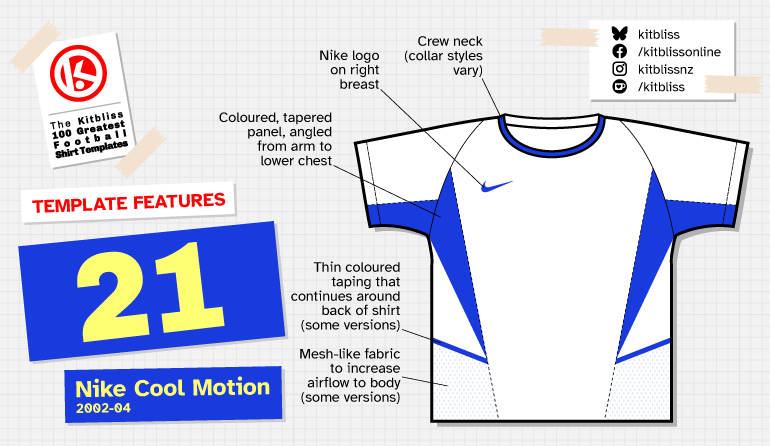
Nike dubbed the concept 'Cool Motion', and the name was more than just marketing twaddle. Unlike many previous Nike designs, which were comparatively simple in their visual composition, the Cool Motion template used contrasting side panels that were tapered into a point, as well as other blocks, shapes, piping and taping to add extra aesthetic interest. Combined with several collar styles, these elements created enough permutations to give each team an identity that felt very much its own.
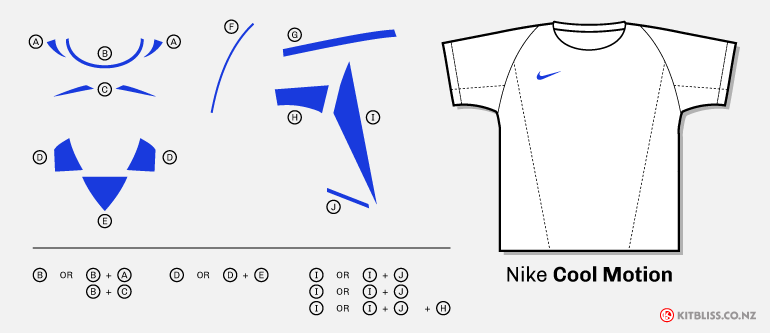
From left: Individual elements of Nike's Cool Motion shirt template.
As for the double-layered fabric of the shirt, the ambition of creating something so futuristic was admirable, but in reality, problematic. During the 2002 World Cup Final, Brazilian defender Edmílson was forced to change his ripped shirt, but due to the complicated way that the two layers were attached, he found it unnecessarily difficult to get his new shirt on.
Diego Forlán ran into similar problems after scoring a goal for Manchester United against Southampton in 2002. Having removed his shirt to celebrate, he was unable to quickly get it back on again. He found himself playing bare-chested when the game restarted, and it was some time before he finally managed to negotiate the complexities of Nike's clever but rather impractical design. Football's lawmakers soon banned players from removing their shirts in celebration, inadvertently ensuring that comic episodes such as this would become a thing of the past.
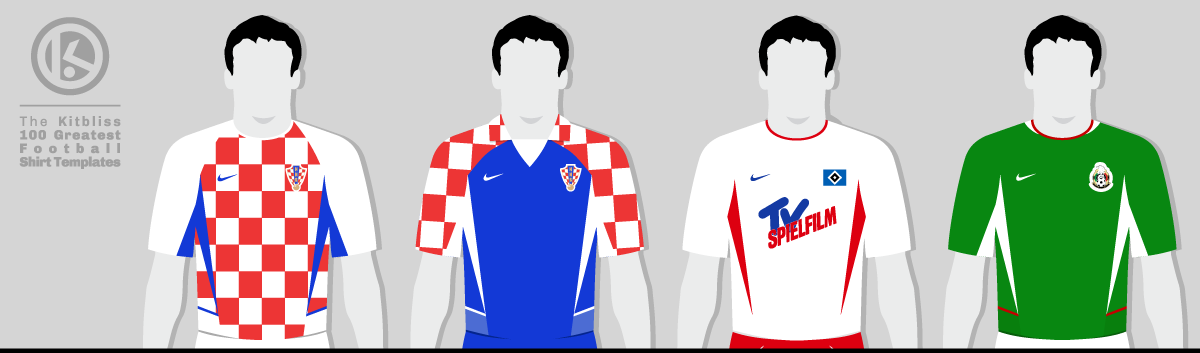
From left: Croatia (2002-03 home and away), Hamburg SV (2002-03 home), Mexico (2003-04 home).
Post-World Cup, a simpler single-layer version of the shirt was worn by a number of teams, often with just a minimal crew neck and tapered panels. In some ways this no-nonsense version lacked some of the character of that which was worn by the likes of Luis Figo, Ronaldinho and Alen Bokšić, but it was a perfectly serviceable template all the same. Perhaps it was those very complexities that made the original so fascinating. The abundance of panels and shapes gave it a potent intricacy that the simplified version inevitably lacked.
It's a template that tends to divide opinion; people seem either to love it or hate it. I fall firmly into the former camp, not least because it gave the public a tangible way of connecting Nike with original design and creativity. Such was the unmistakable look of the template that aspects of it have reappeared in the years that followed. England's shirts from the 2003 Rugby World Cup, one or two Admiral shirts from around the same time and several of Nike's subsequent football kit templates all tip their hat to the original, and rightly so.
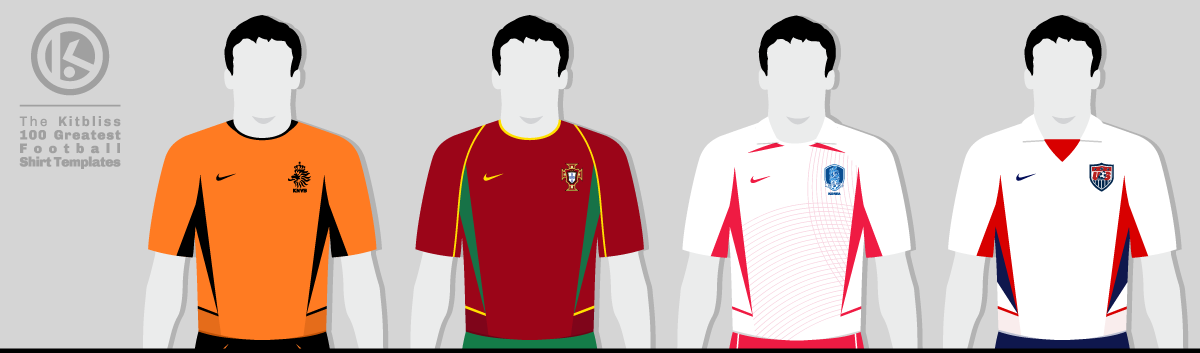
From left: Netherlands (2002-03 home), Portugal (2002-03 home), South Korea (2002 and 2004 away), USA (2002-04 home).
In 2004, Cool Motion gave way to Total 90, a template which had its own visual language, but the ethos remained - design that was clearly not Adidas, but created with just as much quality and care. Nike had finally made their mark with a template that demanded attention during a World Cup tournament, and many more were to follow. It would also provide the perfect launch pad for Nike's rise to prominence in British football and beyond over the years that followed.
My very grateful thanks go to Adam's Shirt Quest and Football Shirt World UK for their help in researching this template.
To see the full set of Nike Cool Motion kits, visit the Nike Cool Motion template gallery page.